KBase + BER Data Lakehouse
A Unified, AI-Native Ecosystem for Accelerating DOE Biological and Environmental Research
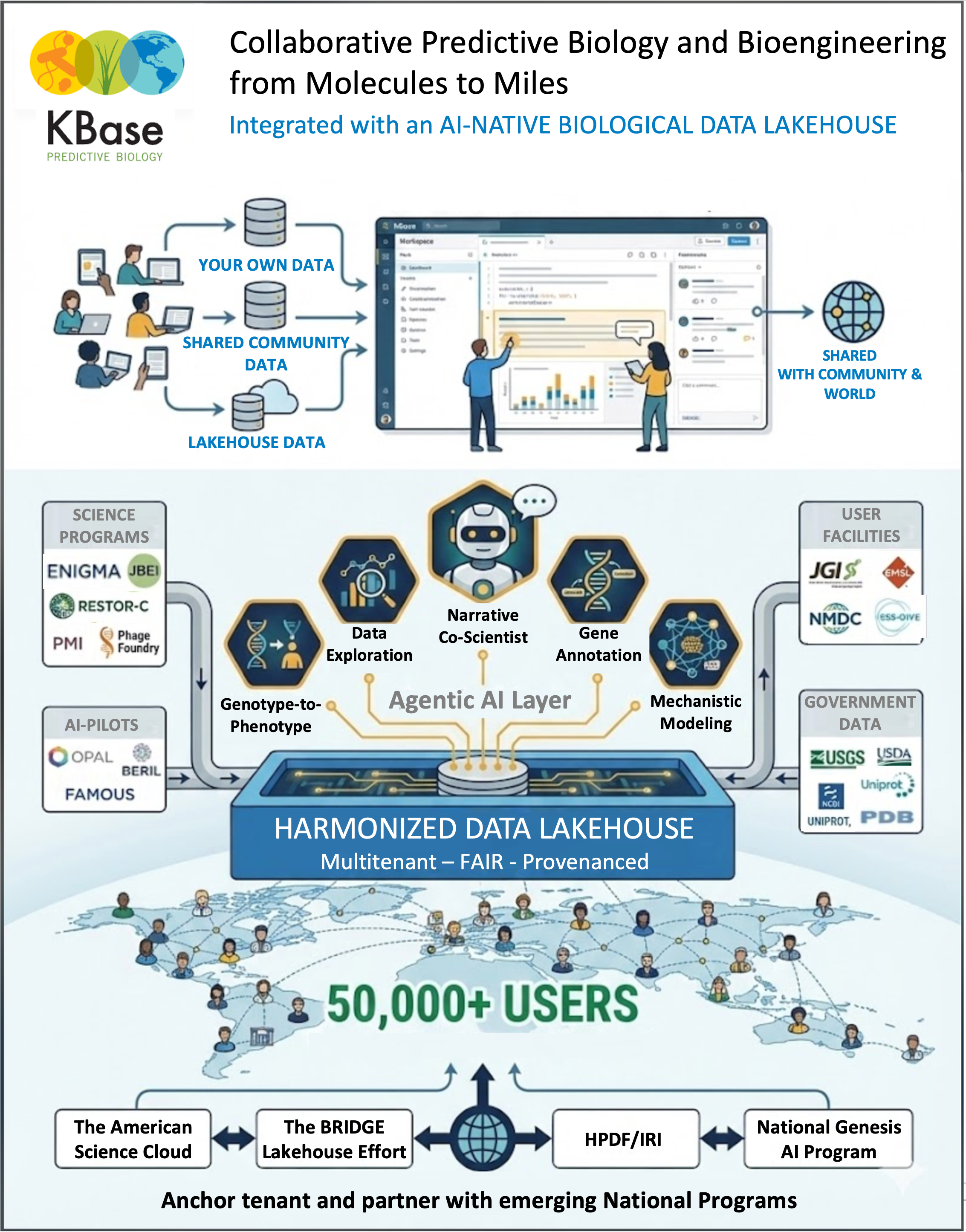
The integration of KBase with the BER-wide Harmonized Data Lakehouse represents a major advancement in DOE’s scientific cyberinfrastructure. This platform brings together diverse biological, environmental, and multi-omics datasets into a single, coherent, AI-ready architecture that supports discovery, collaboration, and mission-driven biological insight at scale.
This capability strengthens DOE’s ability to transition from data collection to predictive biology and integrative bioengineering, serving national needs in sustainable bioenergy, climate resilience, carbon cycling, and biotechnology.
1. A Harmonized National Data Asset for BER
DOE programs increasingly generate massive, heterogeneous datasets that are challenging to integrate across domains. The Lakehouse solves this by providing:
A unified, multitenant, FAIR-compliant data foundation
- Standardized data structures across BER programs
- Built-in provenance and version tracking
- Consistent metadata, enabling cross-domain synthesis
- A scalable backbone supporting tens of thousands of users
This architecture is designed to support long-term stewardship of DOE biological and environmental data.
2. Transforming KBase into an AI-Native Scientific Ecosystem
KBase’s long-standing strength is its narrative-driven platform for computational biology. When integrated with the Lakehouse, KBase evolves into a next-generation scientific ecosystem that enables:
AI-enhanced hypothesis generation and interpretation
AI agents can explore harmonized datasets, identify connections, and support decision-making.
Automated gene annotation, modeling, and data interpretation
AI-powered workflows scale analyses that previously required expert manual effort.
Narrative co-scientists assisting researchers
AI copilots help users build analyses, interpret results, and communicate findings.
Integration of genotype-to-phenotype reasoning across national datasets
Large-scale patterns become discoverable because data are harmonized and centrally accessible.
These capabilities position KBase to serve as a national hub of AI-enabled biological reasoning.
3. Enabling Collaboration and Reuse Across BER Programs
By harmonizing data across environmental, microbial, genomic, and multi-omics domains, the Lakehouse:
- Breaks down data silos across JGI, ESS-DIVE, NMDC, EMSL, ARM, and other facilities
- Provides a shared analytics infrastructure for cross-program initiatives
- Ensures reproducibility through secure, versioned datasets
- Allows scientists to build on each other's work through shared narratives, workflows, and AI agents
This creates a collaborative data ecosystem across BER, reducing duplication and accelerating innovation.
4. Scalable Infrastructure Supporting 50,000+ Users
KBase already serves a global community of over 50,000 users. With the Lakehouse:
- Large multi-omics and environmental datasets can be processed efficiently
- Scalable infrastructure meets increasing computational demands
- Community-contributed analyses can seamlessly integrate national datasets
- Shared public and user-generated outputs enrich DOE’s scientific knowledge base
DOE investments thus reach a wide and expanding community of researchers, educators, and innovators.
5. Building the Foundation for National-Scale AI Programs
The integrated KBase-Lakehouse ecosystem aligns with multiple emerging DOE and federal priorities:
AI for Science and Biosecurity
A structured, provenance-rich data ecosystem is essential for training robust, trustworthy biological AI models.
American Science Cloud and BRIDGE Lakehouse Effort
KBase provides a user-facing, scientific workflow environment; Lakehouse provides harmonized data beneath it.
National Genomics and Biosystems Mission Programs
Mechanistic modeling, genotype-to-phenotype pipelines, and large-scale analysis benefit directly from this infrastructure.
Climate and Environmental Prediction
Coupling biological and environmental data supports integrated Earth system assessments.
This architecture provides a strategic, extensible foundation for future national AI and data initiatives.
6. Why This Matters for DOE
Impact Summary for DOE Leadership
The KBase + BER Lakehouse ecosystem delivers: - A unified data infrastructure for BER that reduces redundancy and fragmentation - AI-native scientific capabilities that dramatically accelerate discovery - A shared platform enabling collaboration across programs and environments - Transparent, reproducible science through standardized provenance and governance - A scalable model ready for national AI and cloud-driven scientific computing initiatives
This integration is not simply a technical upgrade—it is an enabling infrastructure for next-generation biological and environmental science at DOE.
7. Strategic Outlook
The integrated platform supports DOE’s long-term vision for:
- Unified biological and environmental knowledge systems
- Predictive modeling from molecules to ecosystems
- Secure, governed, scalable national data assets
- AI-driven scientific assistance for researchers
- Flexible infrastructure for current and emerging mission needs
With continued investment, KBase and the BER Lakehouse together form the cornerstone of a national biological data and AI ecosystem, equipping DOE to lead in the era of data-intensive, AI-accelerated science.